

Extensive giant cell tumor involving the entire tibia with talar extension and pulmonary metastases is exceptionally rare. In selected patients with unresectable disease or those declining amputation, combined selective angioembolization and denosumab therapy may provide durable disease control and successful limb preservation.
Dr. Ashish Gulia, Department of Bone and Soft Tissue, Homi Bhabha Cancer Hospital and Research Centre, Tata Memorial Centre, Homi Bhabha National Institute, New Chandigarh, Punjab, India. E-mail: aashishgulia@gmail.com
Abstract
Introduction: Giant cell tumor of bone (GCTB) is a benign but locally aggressive neoplasm with a recognized propensity for recurrence and occasional pulmonary metastasis. Diffuse involvement of an entire long bone is exceptionally rare.
Case Report: A 29-year-old female with four previous surgeries for recurrent distal tibial giant cell tumor presented with extensive involvement of the entire tibia, talar extension, and pulmonary metastases. Histopathology and H3.3G34W immunostaining confirmed the diagnosis. Limb salvage reconstruction was not feasible and amputation was declined. Selective angioembolization followed by denosumab 120 mg monthly for 6 months resulted in significant clinical improvement and disease stabilization. At 24 months, the patient remained independently ambulatory with stable local and pulmonary disease.
Conclusion: Combined angioembolization and denosumab may provide durable disease control and limb preservation in selected patients with extensive unresectable GCTB.
Keywords: Giant cell tumor, tibia, pulmonary metastases, denosumab, angioembolization, limb salvage.

Giant cell tumor of bone (GCTB) accounts for approximately 5% of primary bone tumors and predominantly affects young adults [1,2]. Although classified as benign, GCTB frequently demonstrates aggressive local behavior, cortical destruction, soft tissue extension, and local recurrence. Pulmonary metastases occur infrequently but are well documented [1,3]. Most lesions arise around the knee and remain confined to a single epiphyseal-metaphyseal region [1,2]. Diffuse involvement of an entire long bone with contiguous extension into adjacent bones is exceedingly uncommon [1,3]. Management of recurrent GCTB remains challenging, particularly when extensive disease compromises reconstructive options [4]. Recent advances in immunohistochemistry and targeted therapies such as denosumab have expanded treatment possibilities for patients with recurrent or unresectable disease [5,6,7]. We report a rare case of recurrent giant cell tumor involving the entire tibia with talar extension and pulmonary metastases successfully managed using selective angioembolization and denosumab [5,6,7,8].
A 29-year-old female presented with progressive pain and swelling of the left lower limb for 1 year. She had previously undergone four surgical procedures for recurrent distal tibial giant cell tumor, including curettage and bone grafting followed by repeat interventions for local recurrence. Clinical examination revealed diffuse swelling extending from the proximal leg to the ankle. The lesion was firm in consistency and associated with ankle deformity and painful restriction of movement. Multiple healed surgical scars were present. There were no constitutional symptoms. Radiographs demonstrated extensive osteolytic destruction involving nearly the entire tibia with cortical thinning and talar extension (Fig. 1a, b, c).
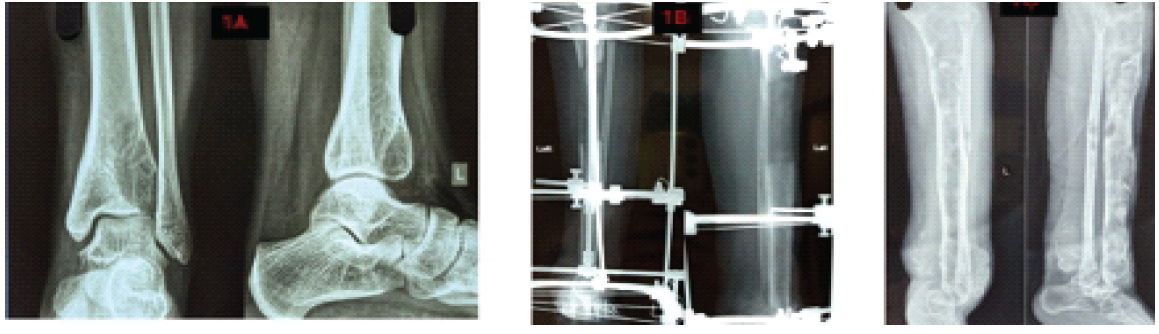
Figure 1: Pre-operative radiographs of the left tibia. (a) Initial presentation. (b) Previous surgical intervention with external fixation. (c) Current radiographs showing extensive lytic destruction.
MRI revealed replacement of the tibial marrow cavity by a large expansile lesion with cortical breaches and soft tissue involvement (Fig. 2a, b, c).
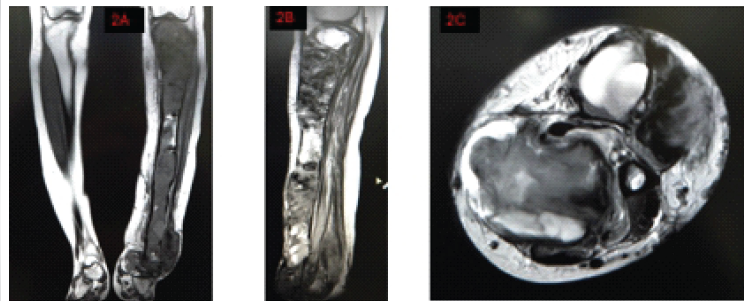
Figure 2: Magnetic resonance imaging demonstrating extensive lesion involvement. (a) Coronal T1-weighted image. (b) Sagittal T2-weighted image. (c) Axial T2-weighted image showing cortical breach and soft tissue extension.
Chest imaging demonstrated multiple bilateral pulmonary nodules suggestive of metastatic disease. Histopathological examination showed mononuclear stromal cells admixed with numerous osteoclast-type multinucleated giant cells. Immunohistochemistry demonstrated positivity for H3.3G34W (Fig. 3a, b, c), confirming the diagnosis of GCTB [9].
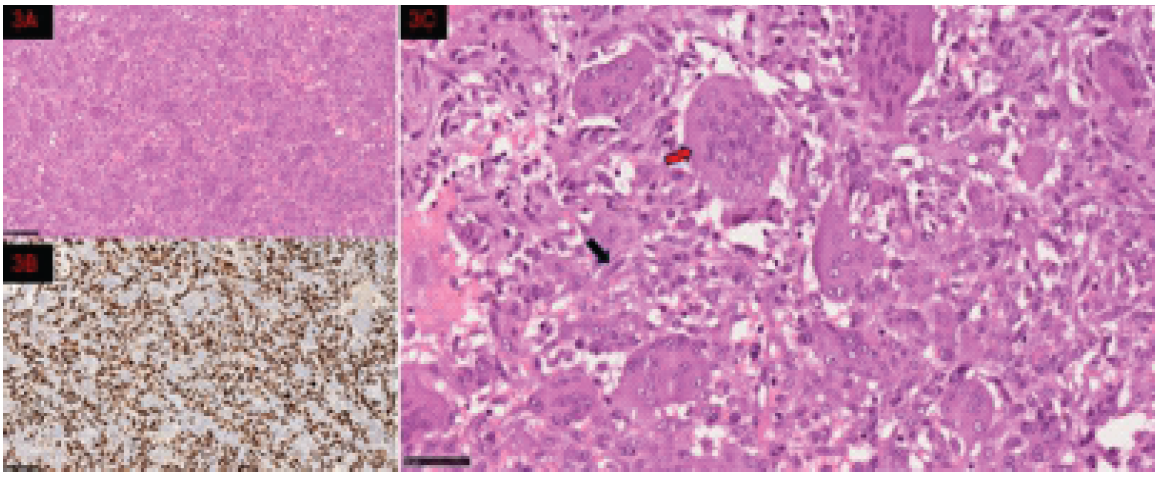
Figure 3: Histopathological and immunohistochemical findings. (a) The section shows sheets of neoplastic mononuclear cells admixed with osteoclast-like giant cells [100x, H&E] (b) H3.3G34W immunostain revealing nuclear positivity in the neoplastic cells and negative in osteoclast-like giant cells [100x] (c) Neoplastic mononuclear cells
and osteoclast-like giant cells indicated by black arrow and red arrow, respectively [200x, H&E]
Selective arterial embolization of the posterior tibial and peroneal arterial supply was performed [8]. Subsequently, denosumab 120 mg was administered subcutaneously every 4 weeks for 6 months [5,6,7]. The patient reported significant reduction in pain and swelling within 2 months. Functional mobility improved progressively. Follow-up imaging at 6 months demonstrated stable local disease without progression. Pulmonary nodules decreased in size. At 24 months of follow-up, the patient remained independently ambulatory with stable radiological findings and no significant treatment-related complications (Fig. 4a, b, c).
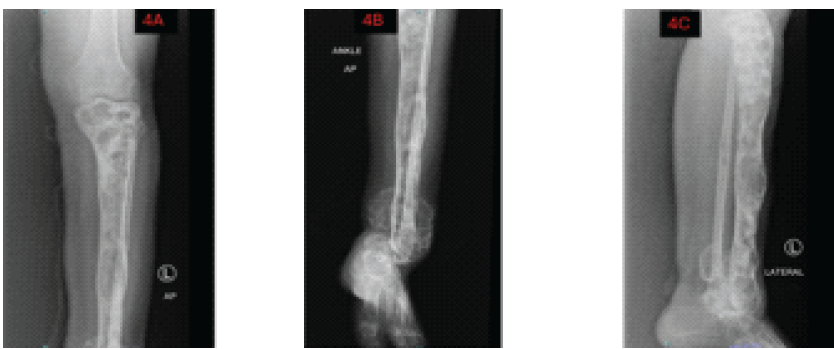
Figure 4: Follow-up radiographs at 24 months. (a,b) Anteroposterior view. (c) Lateral view showing disease stabilization.
This case is remarkable because of the simultaneous presence of complete tibial involvement, contiguous talar extension, multiple recurrences, and pulmonary metastases. Most giant cell tumors remain localized around the epiphyseal region of a single bone. Diffuse involvement of an entire long bone is extraordinarily uncommon and creates major challenges for both oncological control and functional reconstruction [1,2,3]. Recurrent disease remains a major concern in GCTB [4]. Multiple previous surgeries may further compromise local anatomy and reduce reconstructive options. In the present case, four prior surgical procedures had already been performed before presentation. The extent of disease made conventional limb salvage reconstruction difficult and unlikely to provide a predictable functional outcome. The diagnosis was strengthened by H3.3G34W immunostaining. This marker has emerged as a highly specific diagnostic tool and is particularly useful in distinguishing GCTB from histological mimics [9]. Its routine incorporation into musculoskeletal pathology practice has improved diagnostic accuracy in recurrent and challenging cases. Denosumab has significantly altered the treatment landscape for advanced GCTB [5,6,7]. By inhibiting RANKL-mediated osteoclast activation, denosumab reduces osteolysis, promotes sclerosis, and may facilitate disease stabilization. Several studies have demonstrated favorable clinical and radiological responses in recurrent, unresectable, and metastatic disease. Selective arterial embolization represents another valuable treatment modality, particularly in highly vascular lesions and in patients for whom surgery is not feasible [8]. Embolization reduces tumor vascularity, improves symptoms, and may complement systemic therapy. In the present case, the combination of embolization and denosumab achieved durable disease control and avoided amputation. Pulmonary metastases in GCTB should not automatically be interpreted as a marker of poor prognosis [1,3]. Unlike conventional sarcomas, metastatic GCTB often demonstrates indolent behavior. Stable disease or regression following denosumab therapy has been reported [5,7]. Our patient demonstrated a reduction in pulmonary nodules during follow-up. An important lesson from this case is the value of individualized treatment planning. Decisions should be based not only on oncological considerations but also on expected function, patient preference, and feasibility of reconstruction. In selected patients, non-operative management may preserve limb function while maintaining acceptable disease control. Long-term surveillance remains essential because local recurrence and disease progression may occur after discontinuation of denosumab [10]. Continued monitoring of pulmonary lesions is equally important.
Extensive giant cell tumor involving the entire tibia with talar extension and pulmonary metastases is exceptionally rare. Combined selective angioembolization and denosumab provided durable disease control, symptom relief, and preservation of limb function in a patient who declined amputation.
In extensive unresectable GCTB, especially when amputation is declined, combining denosumab therapy and selective angioembolization may provide an effective limb-preserving treatment strategy.
References
- 1. Tsukamoto S, Mavrogenis AF, Kido A, Errani C. Current concepts in the treatment of giant cell tumors of bone. Cancers (Basel) 2021;13:3647. [Google Scholar] [PubMed]
- 2. Gulia A, Puri A, Agarwal M. ABC of giant cell tumours of bone: Advances in the 21st century. Indian J Orthop 2020;54:249-58. [Google Scholar] [PubMed]
- 3. Van Der Heijden L, Dijkstra S, Van De Sande M, Gelderblom H. Current concepts in the treatment of giant cell tumour of bone. Curr Opin Oncol. 2020;32:332-8. [Google Scholar] [PubMed]
- 4. Pitsilos C, Givissis P, Papadopoulos P, Chalidis B. Treatment of recurrent giant cell tumor of bones: A systematic review. Cancers (Basel) 2023;15:3287. [Google Scholar] [PubMed]
- 5. Palmerini E, Chawla NS, Ferrari S, Grimer RJ, Staals EL, Sankhala KK, et al. Denosumab in advanced/unresectable giant-cell tumor of bone: For whom, when, and how long? Eur J Cancer 2021;147:121-8. [Google Scholar] [PubMed]
- 6. Gulia A, Puri A. Role of denosumab in giant cell tumor of bone management. J Orthop Case Rep 2021;11:9-13. [Google Scholar] [PubMed]
- 7. Palmerini E, Staals EL, Al-Absi E, Ferrari S, Donati D, Longhi A, et al. Denosumab in giant cell tumor of bone: Latest evidence and clinical perspectives. Ther Adv Med Oncol 2022;14:17588359221074874. [Google Scholar] [PubMed]
- 8. Bianchi G, Donati D, Di Bella C, Mercuri M. Embolization in giant cell tumors of bone: Technique and results. Clin Orthop Relat Res 2011;469:3201-6. [Google Scholar] [PubMed]
- 9. Rekhi B, Dave V, Butle A, Dharavath B, Khetale S, Redhu AK, et al. Immunohistochemical expression of H3.3G34W in 100 giant cell tumors of bone and its diagnostic mimics, including its value in resolving uncommon diagnostic scenarios: A single institutional study at a tertiary cancer referral center, India. Indian J Pathol Microbiol 2024;67:542-52. [Google Scholar] [PubMed]
- 10. Errani C, Tsukamoto S, Leone G, Akahane M, Cevolani L, Tanzi P, et al. Denosumab may increase risk of local recurrence in patients with GCTB treated with curettage. J Bone Oncol 2022;34:100438. [Google Scholar] [PubMed]




Related Articles in Journal of Orthopaedic Case Reports
 September 1, 2026 Limb Salvage for Entire Tibial Ewing Sarcoma in a 4-year-Old Child Using Extracorporeal Irradiation and Free Flap Reconstruction: A Case Report and Surgical Technique
 May 1, 2026 Combined Post-operative Denosumab and Oral Bisphosphonate Therapy Following Resection of Spinal Giant Cell Tumor: A Case Report
 March 1, 2026 Functional Outcome of Curettage and Chemical Cauterization with Bone Grafting and Fixation with Neo-Adjuvant Denosumab Therapy in a Case of Giant Cell Tumor of Navicular Bone of a Young Adult – A Case Report
 August 1, 2025 A Case Report of a Rare Entity – Lateral End of Clavicle Chondromyxoid Fibroma which was Mistaken as Giant Cell Tumor and Aneurysmal Cyst