

Traditional manipulation and delayed treatment of contaminated open fractures in unimmunized children can result in generalized tetanus, highlighting the importance of timely tetanus prophylaxis and definitive fracture care.
Dr. Chirag Sharma, Department of Orthopaedics, North Eastern Indira Gandhi Regional Institute of Health and Medical Sciences, Shillong, Meghalaya, India. E-mail: chiragammu@gmail.com
Abstract
Introduction: Tetanus is an uncommon but potentially life-threatening infection in the era of widespread immunisation. However, it continues to occur in developing regions, particularly following contaminated injuries and delayed access to appropriate medical care. We report a rare case of generalised tetanus developing after traditional manipulation of an open supracondylar humerus fracture in a child.
Case Report: A 12-year-old boy sustained an open supracondylar fracture of the right humerus following trauma. Before receiving definitive treatment, local manipulation and massage of the injured limb were performed. Initial management at another healthcare facility included wound dressing and Kirschner wire fixation. Subsequently, the child presented to our tertiary care centre with severe pain, trismus, and generalised muscle spasms consistent with generalised tetanus. He was admitted to the paediatric intensive care unit and managed with human tetanus immunoglobulin, intravenous metronidazole, diazepam-based spasm control, supportive care, and orthopaedic supervision. During hospitalisation, he developed autonomic instability characterised by labile hypertension and tachycardia, which was managed medically. He did not require mechanical ventilation. During the course of treatment, the fixation wires loosened and were displaced. Revision surgery and debridement were advised; however, consent was declined by the parents. Conservative treatment was therefore continued. After approximately 2 months of hospitalisation, the patient recovered from tetanus, the wound healed satisfactorily, and the fracture united with malunion.
Conclusion: This case highlights the ongoing risk of tetanus following contaminated open fractures, particularly when definitive treatment is delayed and traditional manipulation is undertaken. Early wound management, appropriate tetanus prophylaxis, timely surgical intervention, and public awareness regarding the hazards of untrained fracture treatment remain essential to prevent such potentially fatal complications.
Keywords: Tetanus, open fracture, supracondylar humerus fracture, traditional bone setting, pediatric trauma, malunion.

Tetanus is a potentially life-threatening neurological disease caused by the toxin-producing bacterium Clostridium tetani. Although the incidence of tetanus has declined considerably following the introduction of routine immunisation programmes, cases continue to occur, particularly in developing countries where contaminated wounds, incomplete vaccination, and delayed medical care remain important risk factors [1,2,3]. Open fractures are especially vulnerable to contamination and require prompt wound care, tetanus prophylaxis, and definitive fracture stabilisation to prevent serious complications [4,5,6]. In many regions, however, injured patients may initially seek treatment from traditional healers or undergo local manipulation before presenting to a healthcare facility. Such practices can delay appropriate management and increase the risk of infection and other adverse outcomes [7]. Generalised tetanus developing after an open supracondylar humerus fracture is rarely reported in children. We present the case of a 12-year-old boy who developed generalised tetanus following traditional manipulation of an open supracondylar humerus fracture. This case highlights the continuing burden of tetanus in resource-limited settings and emphasises the importance of early wound management, timely tetanus prophylaxis, and definitive orthopaedic care [8].
A 12-year-old unimmunised boy presented to our tertiary care centre with an open supracondylar fracture of the right humerus following trauma. Following the injury, he was managed by a traditional healer for approximately 2 weeks with local massage and application of herbal poultices. During this period, he did not receive tetanus prophylaxis or definitive wound care. The open wound over the elbow region at presentation is shown in Fig. 1.
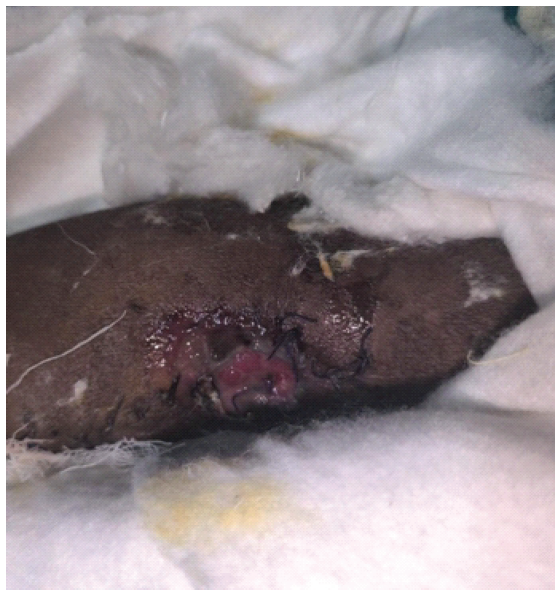
Figure 1: Clinical photograph showing the open wound over the right elbow following trauma.
Subsequently, he developed fever and poor oral intake and was taken to a local hospital, where wound dressing and Kirschner wire (K-wire) fixation of the fracture were performed. Radiographs obtained at presentation to our institution demonstrated a supracondylar humerus fracture with K-wires in situ (Fig. 2).
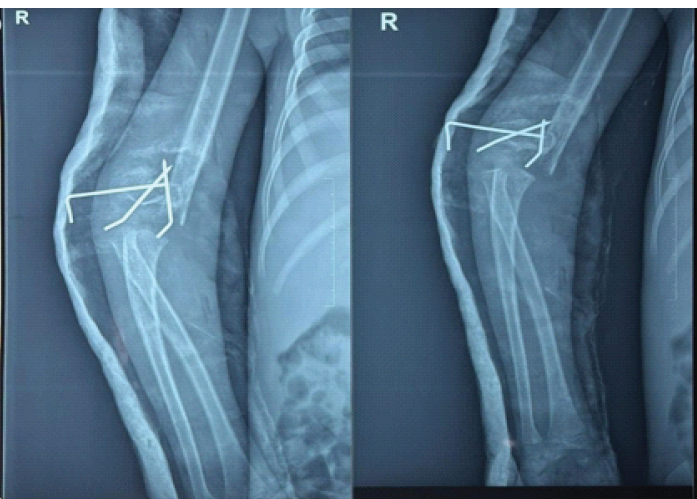
Figure 2: Anteroposterior and lateral radiographs of the right elbow demonstrating a displaced supracondylar humerus fracture with Kirschner wires in situ at presentation.
He was later referred to our institution for further management. On presentation, the patient was conscious and orientated with normal higher mental functions but exhibited trismus and generalised muscle spasms, raising clinical suspicion of generalised tetanus. There was no opisthotonus. The diagnosis was supported by the history of an unimmunised status, an open contaminated wound, delayed presentation, lack of tetanus prophylaxis, and prior unsterile manipulation of the injured limb. The patient was admitted to the paediatric intensive care unit and managed jointly by paediatric and orthopaedic teams. Human tetanus immunoglobulin and intravenous metronidazole were administered. Muscle spasms were controlled with intravenous diazepam. During hospitalisation, he developed autonomic instability characterised by labile hypertension and tachycardia, which was managed with clonidine and labetalol. Additional supportive measures included nursing in a dark, quiet room with minimal external stimulation to reduce spasm triggers. The patient did not require endotracheal intubation or mechanical ventilation. Orthopaedic management consisted of immobilisation of the affected limb with an above-elbow slab and serial wound dressings. During the course of treatment, the fracture fixation became unstable, and the K-wires gradually loosened and were displaced. Revision fixation with wound debridement was advised; however, consent for further surgical intervention was declined by the parents despite counselling regarding the potential risks and consequences. Conservative treatment was therefore continued. The patient remained in the paediatric intensive care unit for approximately 2 months until complete resolution of muscle spasms and autonomic instability. At the time of transfer to the orthopaedic unit, he was ambulatory, independent in activities of daily living, and free of neurological deficits. The fracture subsequently united with malunion. Before discharge, tetanus toxoid immunisation was administered, and the patient was advised regular follow-up for assessment of functional recovery and consideration of future corrective procedures if required.
Although tetanus has become increasingly uncommon following the widespread use of vaccination, it remains a serious and potentially fatal disease in unimmunised individuals. Children presenting with contaminated wounds and open fractures continue to be at risk, particularly in resource-limited settings where access to timely medical care may be delayed [1,2,3]. The present case is unusual because generalised tetanus developed following an open supracondylar humerus fracture in an unimmunised child, further complicated by traditional manipulation of the injured limb before definitive treatment. The diagnosis in our patient was primarily clinical and was based on the presence of trismus and generalised muscle spasms in the setting of an unimmunised child with a contaminated open fracture and delayed presentation. Open supracondylar fractures are uncommon injuries and are generally associated with a higher risk of infection than closed fractures. Present evidence supports early debridement, antibiotic administration, tetanus prophylaxis, and stable fracture fixation to achieve favourable outcomes [4,5,6]. In our patient, however, local manipulation of the injured limb was performed before presentation to a healthcare facility. Traditional fracture treatment practices remain prevalent in many parts of the developing world and often contribute to delayed presentation and increased complication rates [7]. The combination of an open injury, delayed definitive care, and lack of immunisation likely played a significant role in the development of tetanus in this case. Previous reports have highlighted the association between traditional fracture treatment and tetanus. Tchuenkam et al. described generalised tetanus following traditional fracture care, while Boi-Dsane et al. reported tetanus developing after treatment of an open fracture by a traditional bonesetter [8,9]. These reports, together with our case, emphasise that tetanus remains an important preventable complication of musculoskeletal trauma, particularly when wound care is inadequate and prophylaxis is delayed. The orthopaedic challenges in this patient were equally significant. Open supracondylar fractures are usually treated with urgent debridement and stable K-wire fixation, with studies reporting excellent outcomes when managed appropriately [5,6,10]. In our patient, the development of generalised tetanus shifted the immediate priority from fracture management to stabilisation of a life-threatening systemic illness. During the course of treatment, the fixation became unstable, and revision surgery was advised. However, consent for further surgery was declined by the parents, leaving conservative treatment as the only feasible option. The fracture eventually united with malunion. While fracture union was achieved, this outcome is less than ideal in an older child because the potential for remodelling is limited. Previous studies have shown that delayed or inadequate treatment of supracondylar fractures may result in deformity, functional limitation, and the need for more complex procedures at a later stage [11,12]. This aspect of the case highlights the difficult decisions clinicians sometimes face when recommended treatment cannot be carried out because of factors beyond medical control. Despite requiring prolonged intensive care and developing autonomic instability in the form of labile hypertension and tachycardia, the patient recovered without the need for mechanical ventilation and was ambulatory and independent at the time of transfer from the paediatric intensive care unit. Another important lesson from this case is the continuing importance of immunisation. Paediatric tetanus remains largely preventable, and studies from developing countries consistently identify incomplete or absent vaccination as a major risk factor [13,14]. The prolonged hospitalisation and intensive multidisciplinary care required by our patient illustrate the substantial burden that can result from a disease that is almost entirely preventable through vaccination. This case serves as a reminder that tetanus should still be considered in unimmunised children presenting with contaminated open fractures. Early wound care, appropriate tetanus prophylaxis, and timely orthopaedic intervention remain essential for preventing serious complications. Equally important is community awareness regarding the risks associated with traditional fracture manipulation and delays in seeking definitive medical care.
Limitations:
The exact timeline of symptom onset and details of the initial treatment received before referral were not fully available. In addition, long-term functional follow-up could not be assessed at the time of reporting. Despite these limitations, the case provides important clinical insights into a rare but preventable complication of an open fracture in an unimmunised child.
Generalised tetanus remains a potentially life-threatening yet preventable complication of contaminated open fractures, particularly in unimmunised children. This case highlights the risks associated with delayed presentation and traditional fracture manipulation, which may contribute to severe infectious complications. Early tetanus prophylaxis, prompt wound debridement, and definitive fracture management are essential to optimise outcomes and prevent avoidable morbidity.
Delayed treatment and traditional manipulation of open fractures can lead to life-threatening tetanus. Early prophylaxis, wound care, and definitive fracture management are essential for preventing such complications.
References
- 1. World Health Organization. Tetanus Fact Sheet. Geneva: World Health Organization; 2024. Available from: https://www.who.int/news-room/fact-sheets/detail/tetanus. Accessed May 12, 2026. [Google Scholar] [PubMed]
- 2. Centers for Disease Control and Prevention. Clinical Features of Tetanus. Atlanta, GA: Centers for Disease Control and Prevention; 2025. Available from: https://www.cdc.gov/tetanus/hcp/clinical-signs/index.html. Accessed May 12, 2026 [Google Scholar] [PubMed]
- 3. Centers for Disease Control and Prevention. Clinical Care of Tetanus. Atlanta, GA: Centers for Disease Control and Prevention; 2025. Available from: https://www.cdc.gov/tetanus/hcp/clinical-care/index.html. Accessed May 15, 2026 [Google Scholar] [PubMed]
- 4. Centers for Disease Control and Prevention. Clinical Guidance for Wound Management to Prevent Tetanus. Atlanta, GA: Centers for Disease Control and Prevention; 2025. Available from: https://www.cdc.gov/tetanus/hcp/clinical-guidance/index.html. Accessed May 15, 2026 [Google Scholar] [PubMed]
- 5. Pan T, Widner MR, Chau MM, Hennrikus WL. Open supracondylar humerus fractures in children. Cureus 2021;13:e13903. [Google Scholar] [PubMed]
- 6. Özkul E, Gem M, Arslan H, Alemdar C, Demirtas A, Kisin B. Surgical treatment outcome for open supracondylar humerus fractures in children. Acta Orthop Belg 2013;79:509-13. [Google Scholar] [PubMed]
- 7. Akar MS, Ulus SA, Durgut F, Dönmez S. Complications and difficulties due to bonesetter in the treatment of pediatric distal humerus fractures. J Clin Trials Exp Invest 2023;2:38-44. [Google Scholar] [PubMed]
- 8. Tchuenkam LW, Ndame EK, Guifo ML, Danwang C, Kalla GC, Essomba A. An unusual complication of the traditional treatment of a closed fracture–generalized tetanus: A case report. J Med Case Rep. 2017;11:298. doi:10.1186/s13256-017-1477-y. [Google Scholar] [PubMed] [CrossRef]
- 9. Boi-Dsane NAA, Seidu AS, Buunaaim ADB. Generalized tetanus in a farmer following treatment of an open ankle fracture by a traditional bone setter. Clin Case Rep. 2023;11:e7579. doi:10.1002/ccr3.7579. [Google Scholar] [PubMed] [CrossRef]
- 10. Boukhentiche A, Benmayouf N, Derdous C, Boudjouraf N, Khernane N. Management of open supracondylar humeral fracture in children: A case report and literature review. Cureus 2023;15:e48119. [Google Scholar] [PubMed]
- 11. Guo M, Xie Y, Su Y. Open reduction of neglected supracondylar humeral fractures with callus formation in children. J Pediatr Orthop 2020;40:e703-7. [Google Scholar] [PubMed]
- 12. Mlinde E, Amlani LM, May CJ, Banza LN, Chokotho L, Agarwal-Harding KJ. Outcomes of nonoperatively treated pediatric supracondylar humeral fractures at the Nkhotakota District Hospital, Malawi. JB JS Open Access 2021;6:e21.00011. [Google Scholar] [PubMed]
- 13. Mondkar SA, Tullu MS, Deshmukh CT, SrinivasaRangan R, Agrawal M. Clinical profile and outcome of pediatric tetanus at a tertiary care center. J Pediatr Intensive Care 2021;10:256-3. [Google Scholar] [PubMed]
- 14. Tadele H. Clinical profile and outcome of pediatrics tetanus: The experience of a Tertiary hospital in Ethiopia. Ethiop J Health Sci 2017;27:559-64. [Google Scholar] [PubMed]






Related Articles in Journal of Orthopaedic Case Reports
 October 1, 2026 Outcomes of Primary Definitive Internal Fixation of Compound Fractures within 72 h of Injury: A Prospective Cohort Study
 June 1, 2026 Staged Reconstruction Strategy for Gustilo Type IIIB and IIIC Open Fractures: A Case Series of 23 Patients
 June 1, 2026 Traditional Bone Setting Leading to Compartment Syndrome of Arm: A Case Report
 February 1, 2026 Intra-articular Corrective Osteotomy for Bennett’s Fracture Malunion: A Rare Case Report