


Introduction
Osteonecrosis of the femoral head (ONFH) in young adults can progress to femoral head collapse and secondary osteoarthritis [1,2]. Joint-preserving procedures, including core decompression, bone grafting, vascularized grafting, and proximal femoral osteotomy, are primarily intended to delay or avoid arthroplasty, particularly before collapse [3–6]. Once substantial collapse or secondary degenerative change is present, the predictability of these procedures decreases, although selected post-collapse patients may still be candidates for head-preserving reconstruction [3,5,6]. In this patient, potential etiologic contributors included approximately 7 months of prednisone exposure and heterozygous Factor V Leiden rather than a strictly idiopathic diagnosis. The remainder of the documented thrombophilia evaluation was negative. Both corticosteroid exposure and thrombophilic states have been associated with ONFH, but the contribution of either factor in an individual patient cannot be established from a single case [7–9]. We therefore present this case as a case-specific treatment decision rather than evidence of superiority of total hip arthroplasty (THA) over joint-preserving surgery.
Case Report
Patient profile and history
A 24-year-old male competitive freestyle wrestler (74 kg weight class) presented with a 6-month history of insidious right groin pain, initially attributed to muscular strain. The pain became constant and progressively limited hip flexion and internal rotation. He reported taking oral prednisone 20 mg/day for approximately 7 months for allergic rhinitis, corresponding to an estimated cumulative exposure of approximately 4.2 g prednisone-equivalent if the reported daily dose was maintained throughout this period. He was subsequently found to be heterozygous for Factor V Leiden. The documented thrombophilia work-up was otherwise negative, including evaluation for other inherited and acquired hypercoagulable conditions. There was no history of trauma, significant alcohol use, sickle cell disease, or systemic lupus erythematosus (Table 1).
Patient demographics and risk-factor profile
| Parameter | Details |
|---|---|
| Age/sex | 24-year-old male |
| Occupation/sport | Competitive freestyle wrestler (74 kg class) |
| Affected side | Right hip |
| Duration of symptoms | 6 months (insidious onset) |
| Key risk factors | Prednisone 20 mg/day for ~7 months (estimated cumulative exposure ~4.2 g if the reported daily dose was maintained); heterozygous Factor V Leiden. Other documented inherited/acquired thrombophilia testing was negative. These findings are considered potential contributors, not proven causes. |
| Excluded causes | Trauma, significant alcohol use, sickle cell disease, systemic lupus erythematosus; other inherited/acquired thrombophilia testing negative. |
| Diagnosis | Advanced osteonecrosis of the femoral head with potential corticosteroid/thrombophilic contributors; not classified as strictly idiopathic. |
| Staging | ARCO Stage IV (with Stage IIIB collapse features)/Ficat Stage III. |
Pre- and post-operative functional outcomes with 9-month follow-up
| Outcome measure | Pre-operative | Post-operative (6 months) | Post-operative (9 months) | Change |
|---|---|---|---|---|
| Harris hip score | 72/100 (Fair) | 94/100 (Excellent) | Approximately unchanged from 6 months | +22 points at 6 months; maintained at 9 months |
| Merle d’Aubigne- Postel score | 11/18 (Moderate) | 17/18 (Excellent) | Approximately unchanged from 6 months | +6 points at 6 months; maintained at 9 months |
| Visual analogue scale pain | 07-Oct | 1.5/10 | Approximately unchanged from 6 months | -5.5 points at 6 months; maintained at 9 months |
| Flexion | 110° | 135° | Approximately unchanged from 6 months | +25° at 6 months; maintained at 9 months |
| Internal rotation | 15° | 35° | Approximately unchanged from 6 months | +20° at 6 months; maintained at 9 months |
| External rotation | 25° | 40° | Approximately unchanged from 6 months | +15° at 6 months; maintained at 9 months |
| Abduction | 35° | 50° | Approximately unchanged from 6 months | +15° at 6 months; maintained at 9 months |
| Return to activity | Limited to light training | Supervised light wrestling drills | Participation in wrestling matches by 9 months; no hip-related issues reported | Progressed from supervised drills to matches |
| Athlete-specific activity score (e.g., KJOC/HAAS) | Not collected | Not collected | Not collected | Not available |
| Objective sport- performance testing | Not performed | Not performed | Objective endurance testing performed; no clinically significant endurance limitation reported | Endurance assessment completed |
HAAS: High-activity arthroplasty score, KJOC: Kerlan-Jobe orthopedic clinic athletic hip score
The corticosteroid exposure and Factor V Leiden status were considered potential contributors rather than definitive causes. The approximately 4.2 g cumulative prednisone-equivalent exposure represents a substantially longer exposure than previously described in the case, but a causal dose-response relationship cannot be established from this individual case. The thrombophilia evaluation was negative apart from Factor V Leiden heterozygosity, and therefore no additional inherited or acquired thrombophilic abnormality was identified.
Physical examination
Pre-operative range of motion of the right hip was as follows: flexion 110° (painful at end-range), internal rotation 15° (markedly restricted), external rotation 25°, and abduction 35°. The flexion, abduction, and external rotation (FABER) and log-roll tests were both positive.
Plain radiographs demonstrated flattening of the superolateral femoral head, a subchondral crescent sign, and early joint-space narrowing (Fig. 1a). Magnetic resonance imaging (MRI) revealed an extensive lesion involving more than 50% of the femoral head, with subchondral collapse, extensive bone marrow edema, a double-line sign on T2-weighted fat-suppressed sequences, and secondary chondral thinning (Fig. 1b and c). The collapse component met the criteria for late Association Research Circulation Osseous (ARCO) Stage III (Stage IIIB, >2 mm depression); however, because the radiographs also demonstrated joint-space narrowing/secondary degenerative change, the final stage was classified as ARCO Stage IV under the 2019 revised ARCO system [10]. No post-operative MRI was performed; post-operative assessment was based on serial plain radiographs and clinical evaluation.
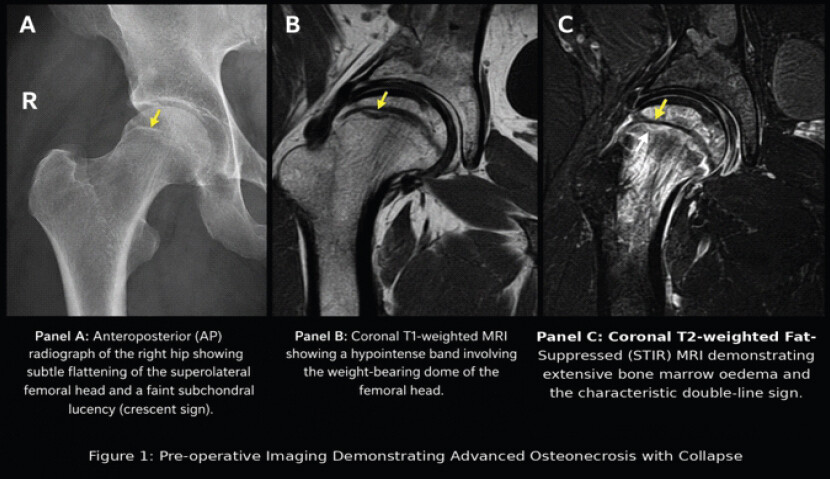
Right-sided advanced ONFH with post-collapse deformity and secondary osteoarthritis, classified as ARCO Stage IV (with ARCO Stage IIIB collapse features)/Ficat Stage III, with potential corticosteroid and thrombophilic contributors.
Despite the patient’s young age, joint-preserving options were considered. Core decompression is best supported for pre-collapse disease, whereas vascularized bone grafting and osteotomy may be considered in selected post-collapse hips but have heterogeneous results and greater technical demands [3,5,6]. In this patient, more than 2 mm of femoral head flattening, involvement of more than 50% of the femoral head, early acetabular chondral compromise, and the requirement for reliable restoration of high-demand function made the expected result of joint-preserving surgery less predictable. THA was therefore selected after discussion of the alternatives, including the potential for later revision in a 24-year-old patient. This was a case-specific treatment decision and not a conclusion that THA is superior to all joint-preserving procedures. The patient subsequently underwent cementless THA through a minimally invasive posterior approach; the surgical details and prosthetic components are summarized in Table 3.
Surgical details and prosthetic components
| Parameter | Details |
|---|---|
| Surgical approach | Minimally invasive posterior approach |
| Femoral component | Cementless, tapered-wedge titanium alloy stem |
| Acetabular component | Cementless porous-coated titanium shell with HXLPE liner |
| Bearing surface | 36 mm metal-on-highly cross-linked polyethylene (MoP) |
| Implant size | Femoral head 36 mm; acetabular cup 50 mm |
| Operative time | 90 min |
| Blood loss | 150 mL |
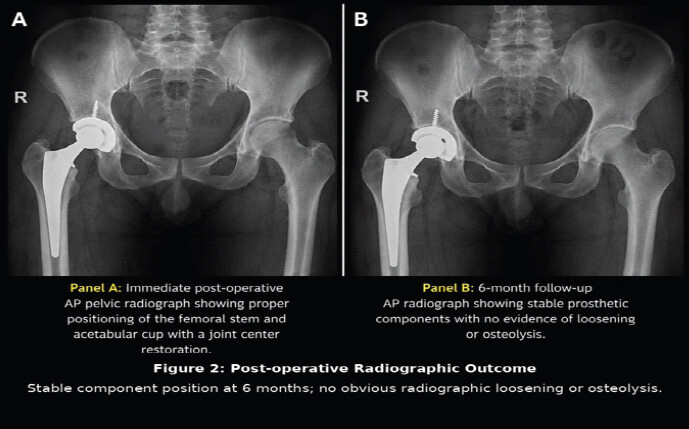
| Complications | No complications reported through 9 months; serial radiographs, including 9-month assessment, showed stable components without obvious loosening or osteolysis. |
HXLPE: Highly cross-linked polyethylene, MoP: Metal-on-polyethylene
At 6-month follow-up, the patient reported minimal pain and near-full range of motion. The Harris hip score (HHS) [11] improved from 72/100 (fair) to 94/100 (excellent), and the Merle d’Aubigné-Postel score [12] improved from 11/18 (moderate) to 17/18 (excellent). Pain on the Visual Analogue Scale (VAS) fell from 7/10 to 1.5/10. Internal rotation improved from 15° to 35°, flexion from 110° to 135°, external rotation from 25° to 40°, and abduction from 35° to 50° (Table 2). At 9 months, these scores and range-of-motion measurements remained approximately unchanged from the 6-month assessment. Serial post-operative plain radiographs, including the 9-month assessment, showed stable, well-positioned components without obvious radiographic loosening, osteolysis, or other abnormality (Fig. 2). No post-operative MRI was performed. Objective endurance testing was performed as part of the sports assessment and did not identify a clinically significant endurance limitation. The patient had progressed from supervised drills to participation in wrestling matches by 9 months and reported no hip-related problems.
THA was traditionally reserved for older patients due to concerns regarding long-term component survivorship [13,14]. Contemporary cementless fixation and highly cross-linked polyethylene have broadened its use in younger patients with advanced ONFH [15], but long-term revision remains an important concern. Contemporary systematic reviews demonstrate substantial functional improvement after THA in young patients, while also showing that survivorship and complication profiles vary with age, diagnosis, implant design, and duration of follow-up [16,17]. These data provide context for counseling but cannot be used to predict the long-term outcome of this individual 24-year-old patient. The present 9-month radiographic stability is reassuring but remains insufficient to assess polyethylene wear, osteolysis, aseptic loosening, instability, or lifetime revision risk.
In this case, the marked improvement in HHS and Merle d’Aubigné-Postel score illustrates restoration of pain-free function, but these general hip scores do not by themselves establish wrestling-specific performance. Athlete-focused instruments such as the Kerlan-Jobe Orthopaedic Clinic (KJOC) athletic hip score and activity scales such as the University of California, Los Angeles (UCLA) activity scale or the High-Activity Arthroplasty Score (HAAS) can provide additional information about sport participation and activity level [18–20]. These measures were not prospectively collected in the present case and therefore cannot be retrospectively added without introducing unsupported data. The patient’s return to wrestling was additionally assessed clinically and included objective endurance testing, which did not demonstrate a clinically significant endurance limitation.
Several considerations are specific to young athletic patients undergoing THA. The posterior approach carries a recognized dislocation risk, and high-impact/contact activity may expose the implant to traumatic injury and potentially increased mechanical demands. Evidence on return to sport after THA is largely derived from heterogeneous patient populations and shows lower and less certain return rates for high-intensity sports than for low- or moderate-impact activities [20]. The literature therefore supports cautious, criterion-based progression rather than an assumption that contact sport is universally safe. In this individual, the patient progressed to wrestling matches by 9 months without reported symptoms or clinical problems. Nevertheless, 9 months remains insufficient to evaluate long-term polyethylene wear, osteolysis, aseptic loosening, instability, periprosthetic fracture, or revision risk.
Rehabilitation and return-to-sport assessment: The post-operative rehabilitation framework was structured in phases consistent with published THA rehabilitation literature [21,22] (Table 4). Early rehabilitation emphasizes gait training, restoration of functional mobility and appropriate hip range of motion, followed by progressive strengthening of the operated limb, including quadriceps and hip-abductor musculature. After approximately 8 weeks, literature supports progression to weight-bearing strengthening, with particular emphasis on hip-abductor eccentric strengthening, together with aerobic/endurance and balance-oriented exercise [21]. Rehabilitation should be progressed according to patient-specific functional responses rather than a fixed timetable, with task-specific training added as strength, gait, balance and endurance improve [22]. For this athlete, progression was subsequently directed toward sport-specific conditioning, including endurance assessment and graded wrestling drills before return to matches at 9 months. Published return-to-sport literature suggests that high-impact/contact activities require careful counseling and monitoring because evidence for their long-term safety after THA remains limited [20].
Literature-informed post-operative rehabilitation framework used for phased recovery and return-to-sport progression
| Rehabilitation phase | Literature-supported components | Application to this case |
|---|---|---|
| Early post-operative phase | Gait/functional mobility training; appropriate hip range-of-motion work; early activation and strengthening of the operated limb. | Supervised physiotherapy with progressive functional recovery. |
| Progressive strengthening phase | Progressive resistance training, including quadriceps and hip-abductor strengthening; progression based on patient-specific functional response rather than a fixed timetable [21,22]. | Strengthening progressed before higher-demand wrestling drills. |
| Late rehabilitation (>8 weeks) | Weight-bearing exercise with emphasis on hip-abductor eccentric strengthening, together with aerobic/endurance and balance training [21,22]. | Endurance assessment and higher-level conditioning were incorporated. |
| Sport-specific progression | Task-specific training and graded progression as strength, gait, balance and endurance improve; high-impact/contact sport requires individualized counseling and monitoring [20, 22]. | Graded wrestling drills preceded return to wrestling matches at 9 months. |
Limitations
This report has several limitations. It describes a single patient, so the findings cannot be generalized to young athletes with advanced ONFH. Follow-up is 9 months; although the patient remains clinically well with stable radiographs, it is still insufficient to establish implant survivorship, polyethylene wear, osteolysis, aseptic loosening, instability, periprosthetic fracture, or lifetime revision risk. Post-operative assessment was based on serial plain radiographs and clinical evaluation; no post-operative MRI was performed, and advanced imaging or standardized radiographic migration/osteolysis measurements were not obtained. Athlete-specific patient-reported measures were not collected, although objective endurance testing was performed. The return to wrestling matches represents an important individual functional outcome but cannot establish the safety of contact sport.
The rehabilitation program was based on a phased, literature-informed approach incorporating gait and functional recovery, progressive strengthening, weight-bearing hip-abductor work, endurance and balance training, followed by sport-specific conditioning [21,22]. However, as with most rehabilitation literature, there is no universally validated protocol or single evidence-based timetable for progression after THA [22]. The patient’s return to wrestling matches at 9 months therefore represents an individualized clinical decision rather than a general recommendation. In addition, the case remains a single observation without a comparative treatment arm; the relative effectiveness of THA versus core decompression, vascularized grafting, osteotomy, or other joint-preserving procedures cannot be inferred.
Conclusion
This case demonstrates that THA can provide sustained functional improvement through 9 months in a young, high-demand athlete with advanced post-collapse ONFH when joint preservation is considered unlikely to provide a predictable result. The patient remained clinically well, had stable plain radiographs, and returned to wrestling matches by 9 months, with approximately maintained hip scores and range of motion and no clinically significant endurance limitation. These findings represent an encouraging individual outcome but do not establish THA as superior to joint-preserving procedures, demonstrate long-term implant durability, or prove the safety of contact wrestling after THA. Larger comparative studies with long-term follow-up are needed before early THA can be recommended routinely for young athletes with ONFH.
Clinical Message
Persistent groin pain in a young athlete should prompt consideration of ONFH, particularly when potential risk factors such as corticosteroid exposure or thrombophilia are present. In patients with advanced collapse and secondary degenerative change, THA may be considered after individualized discussion of joint-preserving alternatives, expected functional goals, activity modification, and lifetime revision risk. In this individual, 9-month follow-up showed stable radiographs, maintained clinical scores and range of motion, satisfactory endurance testing, and return to wrestling matches without reported hip-related problems. These findings support a case-specific decision for THA rather than a general recommendation for young athletes.
Conflict of Interest:
Nil
Source of Support:
Nil
Consent
The authors confirm that informed consent was obtained from the patient for publication of this article
How to Cite this Article
Raj S, Sharma K, Jose A, Das S, Kumar R, Goni V. Total Hip Arthroplasty for Advanced Femoral Head Osteonecrosis in a 24-Year-Old Competitive Wrestler: A Case Report. Journal of Orthopaedic Case Reports 2026 October;16(10): 208-214.
References
- Mont MA, Hungerford DS. Non-traumatic avascular necrosis of the femoral head. J Bone Joint Surg Am 1995;77:459-74. [Google Scholar] | [PubMed]
- Lavernia CJ, Sierra RJ, Grieco FR. Osteonecrosis of the femoral head. J Am Acad Orthop Surg 1999;7:250-61. [Google Scholar] | [PubMed]
- Petek D, Hannouche D, Suva D. Osteonecrosis of the femoral head: Pathophysiology and current concepts of treatment. EFORT Open Rev 2019;4:85-97. [Google Scholar] | [PubMed]
- Moya-Angeler J, Gianakos AL, Villa JC, Ni A, Lane JM. Current concepts on osteonecrosis of the femoral head. World J Orthop 2015;6:590-601. [Google Scholar] | [PubMed]
- Dubé MD, Emara AK, Deren ME, Pasqualini I, Rullan PJ, Tidd J. Techniques of core decompression in the treatment of idiopathic avascular necrosis of the femoral head. Arch Orthop Trauma Surg 2025;145:82. [Google Scholar] | [PubMed]
- Parikh RR, Mirzaei A, Butler ME, Restrepo DJ, Guarin Perez SF, Brandt S. Diagnosis and treatment of nontraumatic osteonecrosis of the femoral head: A systematic review and meta-analyses for the ARCO clinical practice guideline development workgroup. Med Sci (Basel) 2026;14:107. [Google Scholar] | [PubMed]
- Björkman A, Svensson PJ, Hillarp A, Burtscher IM, Rünow A, Benoni G. Factor V Leiden and prothrombin gene mutation: Risk factors for osteonecrosis of the femoral head in adults. Clin Orthop Relat Res 2004;425:168-72. [Google Scholar] | [PubMed]
- Glueck CJ, Freiberg RA, Wang P. Heritable thrombophilia-hypofibrinolysis and osteonecrosis of the femoral head. Clin Orthop Relat Res 2008;466:1034-40. [Google Scholar] | [PubMed]
- Mont MA, Pivec R, Banerjee S, Issa K, Elmallah RK, Jones LC. High-dose corticosteroid use and risk of hip osteonecrosis: Meta-analysis and systematic literature review. J Arthroplasty 2015;30:1506-12.e5. [Google Scholar] | [PubMed]
- Yoon BH, Mont MA, Koo KH, Chen CH, Cheng EY, Cui Q. The 2019 revised version of Association Research Circulation Osseous staging system of osteonecrosis of the femoral head. J Arthroplasty 2020;35:933-40. [Google Scholar] | [PubMed]
- Harris WH. Traumatic arthritis of the hip after dislocation and acetabular fractures: Treatment by mold arthroplasty. An end-result study using a new method of result evaluation. J Bone Joint Surg Am 1969;51:737-55. [Google Scholar] | [PubMed]
- D'Aubigne RM, Postel M. Functional results of hip arthroplasty with acrylic prosthesis. J Bone Joint Surg Am 1954;36-A:451-75. [Google Scholar] | [PubMed]
- Berry DJ, Harmsen WS, Cabanela ME, Morrey BF. Twenty-five-year survivorship of two thousand consecutive primary Charnley total hip replacements: Factors affecting survivorship of acetabular and femoral components. J Bone Joint Surg Am 2002;84:171-7. [Google Scholar] | [PubMed]
- Schmitz MW, Busch VJ, Gardeniers JW, Hendriks JC, Veth RP, Schreurs BW. Long-term results of cemented total hip arthroplasty in patients younger than 30 years and the outcome of subsequent revisions. BMC Musculoskelet Disord 2013;14:37. [Google Scholar] | [PubMed]
- Kim YH, Oh SH, Kim JS, Koo KH. Contemporary total hip arthroplasty with and without cement in patients with osteonecrosis of the femoral head. J Bone Joint Surg Am 2003;85:675-81. [Google Scholar] | [PubMed]
- Zampogna B, Ferrini A, Zampoli A, Talesa GR, Giusti S, Papalia GF. Total hip arthroplasty in patients under 35?years: A systematic review of the last 2 decades studies. Hip Int 2025;35:92-101. [Google Scholar] | [PubMed]
- Swarup I, Shields M, Mayer EN, Hendow CJ, Burket JC, Figgie MP. Outcomes after total hip arthroplasty in young patients with osteonecrosis of the hip. Hip Int 2017;27:286-92. [Google Scholar] | [PubMed]
- Papaliodis DN, Banffy MB, Limpisvasti O, Mohr K, Mehran N, Photopoulos CD. The development and validation of a subjective assessment tool for the hip in the athletic population. Am J Sports Med 2017;45:2517-23. [Google Scholar] | [PubMed]
- Mørup-Petersen A, Skou ST, Holm CE, Holm PM, Varnum C, Krogsgaard MR. Measurement properties of UCLA activity scale for hip and knee arthroplasty patients and translation and cultural adaptation into Danish. Acta Orthop 2021;92:681-8. [Google Scholar] | [PubMed]
- Pasqualini I, Emara AK, Rullan PJ, Pan X, Simmons HL, Klika AK. Return to sports and return to work after total hip arthroplasty: A systematic review and meta-analysis. JBJS Rev 2023;11:e22.00249. [Google Scholar] | [PubMed]
- Di Monaco M, Vallero F, Tappero R, Cavanna A. Rehabilitation after total hip arthroplasty: A systematic review of controlled trials on physical exercise programs. Eur J Phys Rehabil Med 2009;45:303-17. [Google Scholar] | [PubMed]
- Konnyu KJ, Pinto D, Cao W, Aaron RK, Panagiotou OA, Bhuma MR. Rehabilitation for total hip arthroplasty: A systematic review. Am J Phys Med Rehabil 2023;102:11-8. [Google Scholar] | [PubMed]
© 2026 Journal of Orthopaedic Case Reports - Published by Indian Orthopaedic Research Group
About the Authors
-

Sharath Raj
-

Kartik Sharma
-

Ajay Jose
-

Souvik Das
-

Romil Kumar
-

Vijay Goni
Related Articles in Journal of Orthopaedic Case Reports
 October 1, 2026 Total Hip Arthroplasty in the Adolescent Population: A Case Series
 July 1, 2026 A Comparative Study of Functional Outcome Following Total Hip Replacement by Posterolateral and Anterolateral Approach
 July 1, 2026 Managing Complications of Total Hip Arthroplasty for Avascular Necrosis Hip Performed Via Anterior Approach
 June 1, 2026 Functional Outcomes of Total Hip Arthroplasty using Modified Harris Hip Score and Oxford Hip Score: A Prospective Study