


Introduction
Total hip arthroplasty is one of the most successful interventions for end-stage hip disease and continues to rise in frequency as the population ages [1]. Medicare-based projections indicate a substantial increase in primary total hip arthroplasty volume through 2060, reflecting a growing number of medically complex patients requiring joint replacement [2]. Current American Academy of Orthopaedic Surgeons guidelines support total hip arthroplasty as an effective intervention for pain relief and functional improvement in advanced hip pathology [3].
As surgical volume expands, surgeons increasingly encounter patients with significant comorbidities such as diabetes, chronic kidney disease, cardiovascular disease, and morbid obesity. Chronic kidney disease is present in a substantial proportion of arthroplasty candidates and is associated with increased post-operative morbidity and mortality [4].
Bleeding complications remain a major post-operative concern. Inherited disorders of hemostasis are increasingly recognized as modifiers of perioperative risk in total hip arthroplasty, with complication profiles that differ according to the specific defect [5]. Total hip arthroplasty is associated with substantial intraoperative blood loss, and post-operative hematoma increases the risk of infection, prolonged recovery, and reoperation [6]. Delayed hematoma formation, occurring weeks after surgery, is uncommon and should prompt investigation for an underlying hemostatic abnormality.
Von Willebrand disease is the most common inherited bleeding disorder and affects up to one percent of the general population [7,8,9,10]. Clinically significant disease is less frequent because of broad phenotypic variability and frequent underdiagnosis. The disorder results from quantitative or qualitative defects in von Willebrand factor, a protein essential for platelet adhesion and for stabilizing circulating factor VIII [11,12]. Orthopedic manifestations include hemarthrosis and early degenerative joint disease. Many adults remain undiagnosed, particularly because age-related increases in von Willebrand factor antigen may mask an underlying activity defect [13,14]. Undiagnosed von Willebrand disease may therefore contribute to atypical or delayed post-operative bleeding after total hip arthroplasty.
This report describes a patient who developed a delayed posterior thigh hematoma 2 weeks after an uncomplicated primary total hip arthroplasty, ultimately leading to a new diagnosis of von Willebrand disease. It underscores the importance of considering occult coagulopathies in unexpected post-operative bleeding and highlights the need for individualized perioperative hemostatic planning.
Case Report
A 61-year-old male with a history of Type 2 diabetes mellitus, hypertension, hyperlipidemia, chronic kidney disease stage 1, chronic obstructive pulmonary disease, peripheral arterial disease, benign prostatic hyperplasia, glaucoma, and morbid obesity (body mass index 42 kg/m2) presented with end-stage degenerative joint disease of the right hip. He denied any personal or family history of a bleeding disorder. Pre-operative laboratory values, including complete blood count and coagulation profile, were within normal limits (Table 1).
Pre-operative laboratory values
| Test | Result | Units | Interpretation |
|---|---|---|---|
| White blood cell count | 6.9 | ×109/L | Normal |
| Hemoglobin | 14 | g/dL | Normal |
| Hematocrit | 42.4 | % | Normal |
| Platelet count | 197 | ×109/l | Normal |
| Mean corpuscular volume | 85 | fL | Normal |
| Mean corpuscular hemoglobin | 28.1 | Pg | Normal |
| Fasting blood sugar | 93 | mg/dL | Normal |
| Serum creatinine | 0.87 | mg/dL | Normal |
| Albumin | 4.8 | g/dL | Normal |
| Sodium | 137 | mmol/L | Normal |
| Potassium | 4.3 | mmol/L | Normal |
| Prothrombin time | 13.9 | seconds | Normal |
| Partial thromboplastin time | 29.4 | seconds | Normal |
| International normalized ratio | 1.04 | Normal |
The patient underwent elective right total hip arthroplasty through a posterolateral approach. Implant components are detailed in Table 2. Estimated intraoperative blood loss was 900 mL, at the upper end of what is typically observed for primary total hip arthroplasty through a posterolateral approach, and no transfusion was required. Hemostasis was satisfactory, and no intraoperative finding suggested an underlying bleeding disorder. Standard perioperative medications included tranexamic acid and prophylactic antibiotics. Negative-pressure wound therapy was applied postoperatively. The patient received enoxaparin 30 mg subcutaneously every 12 h for 4 days for venous thromboembolism prophylaxis. His initial post-operative course was unremarkable, with no wound drainage, expanding subcutaneous mass, or ecchymosis to suggest active bleeding.
Implant specifications for primary right total hip arthroplasty
| Component | Implant details | Manufacturer |
|---|---|---|
| Acetabular cup | G7 acetabular cup, 52 mm | Zimmer Biomet |
| Liner | 10° polyethylene liner | Zimmer Biomet |
| Femoral stem | Avenir H.O. stem, size 5 | Zimmer Biomet |
| Femoral head | 36 mm +0 Biolox ceramic head | Zimmer Biomet |
| Neck length | Standard | Zimmer Biomet |
| Surgical approach | Posterolateral | Not applicable |
Approximately 2 weeks after surgery, and more than 1 week after enoxaparin had been discontinued, the patient developed progressive swelling and pain of the right posterior thigh and gluteal region with extensive ecchymosis. Physical examination demonstrated a tense, fluctuant mass with overlying skin ecchymosis. His hemoglobin declined from 11.0 g/dL on the day of presentation to 8.9 g/dL over the following days, although no transfusion was required. Radiographs demonstrated well-positioned components with increased soft-tissue fullness around the hip (Fig. 1).
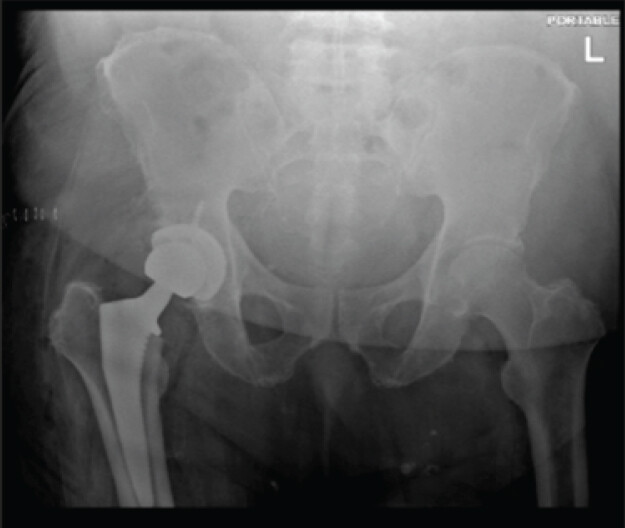
The patient underwent surgical evacuation of the collection, which yielded 400 mL of organized hematoma. No discrete arterial or venous bleeding source was identified despite careful inspection, and additional intraoperative blood loss was approximately 50 mL. Negative-pressure therapy was reapplied. Given the unusually delayed presentation, a hematologic evaluation was obtained. Laboratory testing showed markedly elevated von Willebrand factor antigen, elevated factor VIII activity, and significantly reduced von Willebrand factor activity, consistent with previously undiagnosed von Willebrand disease (Table 3).
Hemostatic evaluation following hematoma development
| Test | Result | Units | Reference interval | Interpretation |
|---|---|---|---|---|
| Factor VIII activity | 174 | % | 56–140 | High |
| von Willebrand factor antigen | 213 | % | 50–200 | High |
| von Willebrand factor activity (ristocetin cofactor) | 13 | % | 50–200 | Low |
| von Willebrand factor activity to antigen ratio | 0.06 | Ratio | 0.70 or greater | Low |
| Factor VIII activity (repeat) | >182 | % | 70–150 | High |
| von Willebrand factor antigen (repeat) | 132.4 | % | 50.6–271.2 | Normal |
| von Willebrand factor activity (repeat) | 156.1 | % | 50.7–203.5 | Normal |
| von Willebrand factor activity to antigen ratio (repeat) | 1.18 | Ratio | 0.70 or greater | Normal |
The patient recovered uneventfully after evacuation, with no recurrence of bleeding. He was referred to hematology for long-term management and perioperative planning for future procedures.
Discussion
This case illustrates the diagnostic challenge that arises when post-operative bleeding deviates from the expected pattern after total hip arthroplasty, especially when the operative technique and protocol were well controlled. As total hip arthroplasty volume rises, an increasing number of patients present with multiple comorbidities that affect hemostasis and wound healing [1,2]. Our patient exhibited several risk factors common in contemporary arthroplasty candidates, including diabetes mellitus, hypertension, chronic kidney disease stage 1, and morbid obesity.
Chronic kidney disease is present in a considerable proportion of total hip arthroplasty patients, although the reported association with higher post-operative mortality is confined to moderate and severe renal insufficiency [4]. Our patient had stage 1 disease with preserved glomerular filtration, so uremic platelet dysfunction is not a plausible contributor, and neither his renal function nor his other comorbidities accounts for a hematoma arising nearly 2 weeks after an uncomplicated procedure. The timing and magnitude of the bleed therefore pointed away from his chronic conditions and toward an unrecognized defect in hemostasis.
von Willebrand disease is the most common inherited bleeding disorder but remains underdiagnosed because many adults display mild or atypical symptoms [7,9]. Defects in von Willebrand factor impair primary hemostasis and reduce factor VIII stability [8,11], explaining why affected individuals may undergo prior surgery without significant bleeding yet develop disproportionate hemorrhage after a major procedure such as total hip arthroplasty. Surgical bleeding has unmasked previously undiagnosed von Willebrand disease in a range of operative settings, but our search did not identify a comparable report following primary total hip arthroplasty.
Recent literature indicates that patients with von Willebrand disease undergoing total hip arthroplasty have higher rates of intraoperative blood loss or post-operative hematoma. Jiang and colleagues reported increased 90-day hematoma rates in patients with von Willebrand disease compared with controls, with outcomes dependent on post-operative anticoagulation [15]. Rugeri and colleagues reported that, when managed with von Willebrand factor replacement guided by daily factor levels, patients with von Willebrand disease undergoing joint replacement had a low frequency of major bleeding and objective hemostatic measures similar to matched controls, although red blood cell transfusion remained more frequent, indicating that protocolized perioperative management substantially mitigates but does not fully eliminate the excess bleeding risk [16]. In contrast, our patient’s von Willebrand disease was undiagnosed at the time of surgery, and he did not receive von Willebrand factor-directed replacement, which may partially explain the large delayed hematoma that developed despite otherwise standard perioperative management.
Our patient had no prior diagnosis and therefore did not receive desmopressin or a von Willebrand factor-containing concentrate preoperatively. He did receive tranexamic acid, which effectively reduces perioperative blood loss in hip and knee arthroplasty [17]. Guidelines suggest that tranexamic acid alone may be adequate for minor procedures in selected patients with baseline von Willebrand factor activity above 0.30 IU/mL. In contrast, major surgery such as total hip arthroplasty typically requires multimodal hemostatic management [18].
Diagnosis is further complicated in older adults because von Willebrand factor antigen levels increase with age, potentially masking a significant functional defect [13,14]. von Willebrand factor is also an acute-phase reactant that rises in response to bleeding, trauma, and other physiologic stress [19]. In this case, a markedly elevated antigen level with severely reduced activity indicated a qualitative impairment consistent with von Willebrand disease despite the high antigen value.
Both sets of hemostatic studies are reported in Table 3. During the acute bleeding episode, von Willebrand factor activity was 13% against an antigen of 213%, giving an activity-to-antigen ratio of 0.06 and indicating a qualitative defect. After clinical stabilization, activity was 156.1% and antigen 132.4%, with a ratio of 1.18. Because an acute-phase response raises antigen and activity in parallel, the rise in von Willebrand factor during the bleeding episode does not by itself account for the markedly reduced activity measured at that time. The two sets of results also carry different reference intervals, indicating measurement on different assay platforms. Multimer analysis and repeat activity testing on an alternative platform would further characterize the defect and inform hemostatic planning for future procedures [12].
The nearly 2-week delay in hematoma development strongly supports a hemostatic etiology rather than mechanical bleeding. Most post-operative hematomas after total hip arthroplasty become clinically apparent within the first 48–72 h [6], and bleeding related to low molecular weight heparin typically occurs during the treatment period itself, while circulating anti-factor Xa activity is present. Enoxaparin has an elimination half-life of approximately 4.5–7 h based on anti-factor Xa activity, and clearance is meaningfully prolonged only in moderate-to-severe renal impairment [20]. In our patient, the collection expanded more than 1 week after enoxaparin had been discontinued, by which point no residual anticoagulant effect would be expected given his preserved renal function. A large, expanding collection at this interval therefore warrants evaluation for an occult coagulopathy or infection.
This case reinforces the need for early hematologic evaluation when bleeding is atypical. Screening with von Willebrand factor antigen, von Willebrand factor activity, and factor VIII levels, combined with a structured bleeding assessment tool, can help identify high-risk patients [12,18]. Early hematology involvement guides desmopressin trials, factor concentrate dosing, and an optimal balance between venous thromboembolism prophylaxis and bleeding risk. The patient recovered well after evacuation and negative-pressure wound therapy, demonstrating that even when von Willebrand disease is diagnosed postoperatively, timely recognition and multidisciplinary management can enable a positive outcome.
Reporting Guideline
This case report was prepared in accordance with the CARE (CAse REport) reporting guideline [21].
Conclusion
Delayed or atypical hematoma after an uncomplicated total hip arthroplasty should prompt evaluation for occult bleeding disorders, including von Willebrand disease. Targeted pre-operative bleeding assessment, especially in patients with unexplained bleeding during prior surgery, may help identify undiagnosed von Willebrand disease and guide personalized hemostatic planning. Prompt surgical management and hematologic evaluation allowed full recovery in this case. Maintaining a high index of suspicion and implementing guideline-based management can reduce morbidity and improve outcomes in high-risk arthroplasty patients.
Clinical Message
A delayed, disproportionate hematoma after uncomplicated total hip arthroplasty warrants prompt evaluation for an occult bleeding disorder such as von Willebrand disease. Because age-related elevation of von Willebrand factor antigen can conceal a functional deficit, clinicians should measure von Willebrand factor activity alongside antigen and factor VIII when bleeding is atypical.
Conflict of Interest:
Nil
Source of Support:
Nil
Consent:
The authors confirm that informed consent was obtained from the patient for publication of this article
References
- Pivec R, Johnson AJ, Mears SC, Mont MA. Hip arthroplasty. Lancet 2012;380:1768–77. Google Scholar | PubMed
- Shichman I, Roof M, Askew N, Nherera L, Rozell JC, Seyler TM. Projections and epidemiology of primary hip and knee arthroplasty in medicare patients to 2040-2060. JBJS Open Access 2023;8:e22.00112. Google Scholar | PubMed
- . American Academy of Orthopaedic Surgeons. Management of Osteoarthritis of the Hip: Evidence-Based Clinical Practice Guideline. Rosemont: American Academy of Orthopaedic Surgeons; 2023. Google Scholar | PubMed
- Jämsä P, Jämsen E, Huhtala H, Eskelinen A, Oksala N. Moderate to severe renal insufficiency is associated with high mortality after hip and knee replacement. Clin Orthop Relat Res 2018;476:1284–92. Google Scholar | PubMed
- Sanchez JG, Jiang WM, Dhodapkar MM, Radford ZJ, Rubin LE, Grauer JN. Total hip arthroplasty in patients who have factor V Leiden: Elevated risks isolated to venous thromboembolism events. J Arthroplasty 2024;39:2421–6. Google Scholar | PubMed
- Smith D, Berdis G, Singh V, Caughran A, Bullock M. Postoperative Fluid Collections in Total Joint Arthroplasty: A Narrative Review. Orthop Res Rev 2022;14:43–57. Google Scholar | PubMed
- Swami A, Kaur V. Von willebrand disease: A concise review and update for the practicing physician. Clin Appl Thromb Hemost 2017;23:900–10. Google Scholar | PubMed
- Sadler JE, Budde U, Eikenboom JC, Favaloro EJ, Hill FG, Holmberg L. Update on the pathophysiology and classification of von Willebrand disease: A report of the Subcommittee on von Willebrand Factor. J Thromb Haemost 2006;4:2103–14. Google Scholar | PubMed
- Du P, Bergamasco A, Moride Y, Truong Berthoz F, Özen G, Tzivelekis S. Von willebrand disease epidemiology, burden of illness and management: A systematic review. J Blood Med 2023;14:189–208. Google Scholar | PubMed
- Bowman M, Hopman WM, Rapson D, Lillicrap D, James P. The prevalence of symptomatic von Willebrand disease in primary care practice. J Thromb Haemost 2010;8:213–6. Google Scholar | PubMed
- Leebeek FWG, Eikenboom JCJ. Von Willebrand's Disease. N Engl J Med 2017;376:701–2. Google Scholar | PubMed
- Nichols WL, Hultin MB, James AH, Manco-Johnson MJ, Montgomery RR, Ortel TL. von Willebrand disease (VWD): Evidence-based diagnosis and management guidelines, the National Heart, Lung, and Blood Institute (NHLBI) Expert Panel report (USA). Haemophilia 2008;14:171–232. Google Scholar | PubMed
- Chapin J. Von Willebrand disease in the elderly: Clinical perspectives. Clin Interv Aging 2018;13:1531–41. Google Scholar | PubMed
- Seidizadeh O, Atiq F, Connell NT, Alavi P, Castaman G, Lillicrap D. Von Willebrand factor and von Willebrand disease in ageing: Mechanisms, evolving phenotypes, and clinical implications. Lancet Haematol 2025;12:e908–17. Google Scholar | PubMed
- Jiang WM, Sanchez JG, Dhodapkar MM, Radford ZJ, Rubin LE, Grauer JN. Outcomes following total hip arthroplasty in patients who have von willebrand disease depend on postoperative anticoagulation. J Arthroplasty 2024;39:2088–93. Google Scholar | PubMed
- Rugeri L, Ashrani AA, Nichols WL, Trousdale RT, Pruthi RK. A single-centre study of haemostatic outcomes of joint replacement in von Willebrand disease and control patients and an analysis of the literature. Haemophilia 2016;22:934–42. Google Scholar | PubMed
- Chen X, Zheng F, Zheng Z, Wu X, Wu C. Oral versus intravenous tranexamic acid in total-knee arthroplasty and total hip arthroplasty: A systematic review and meta-analysis. Medicine (Baltimore) 2019;98:e15248. Google Scholar | PubMed
- Connell NT, Flood VH, Brignardello-Petersen R, Abdul-Kadir R, Arapshian A, Couper S. ASH ISTH NHF WFH 2021 guidelines on the management of von Willebrand disease. Blood Adv 2021;5:301–25. Google Scholar | PubMed
- Kahlon A, Grabell J, Tuttle A, Engen D, Hopman W, Lillicrap D. Quantification of perioperative changes in von Willebrand factor and factor VIII during elective orthopaedic surgery in normal individuals. Haemophilia 2013;19:758–64. Google Scholar | PubMed
- Sanderink GJ, Guimart CG, Ozoux ML, Jariwala NU, Shukla UA, Boutouyrie BX. Pharmacokinetics and pharmacodynamics of the prophylactic dose of enoxaparin once daily over 4 days in patients with renal impairment. Thromb Res 2002;105:225–31. Google Scholar | PubMed
- Gagnier JJ, Kienle G, Altman DG, Moher D, Sox H, Riley D. The CARE guidelines: Consensus-based clinical case reporting guideline development. J Med Case Rep 2013;7:223. Google Scholar | PubMed
© 2026 Journal of Orthopaedic Case Reports - Published by Indian Orthopaedic Research Group
About the Authors
-

Derick Rodríguez-Reyes
-

Hiram E Luigi-Martínez
-

Joseph Salem-Hernández
-

Francis Robles-Torres
-

Lorenzo Acevedo
-

Rafael Fernández-Soltero
Related Articles in Journal of Orthopaedic Case Reports
 August 1, 2026 Total Hip Arthroplasty without Subtrochanteric Shortening Osteotomy in a Neglected Posterior Hip Dislocation: A Case Report
 August 1, 2026 Case Report of Rapidly Destructive Osteoarthritis of the Hip following Multiple High-dose Intra-articular Steroid Injections
 August 1, 2026 Total Hip Arthroplasty in Bilateral Ankylosed Hip by Direct Anterior Approach: A Case Report with Technical Tips
 August 1, 2026 Metallosis Following Total Hip Arthroplasty: A Case Report